by Ray Bassett
The subject matter of this book, “A Bitter Harvest”, should be of major concern to us all. The murder of Seán Brown, a friend and neighbour of Nobel Prize winner Seamus Heaney. was carried out as a deep and dark operation. That an individual, who cultivated cross community links and described by follow club man, Laurence Diamond, as “a great human being”, should have been marked out for such an horrific fate, seems almost beyond comprehension. Seán Brown represented decency and community which makes what happened to him all the more unfathomable.
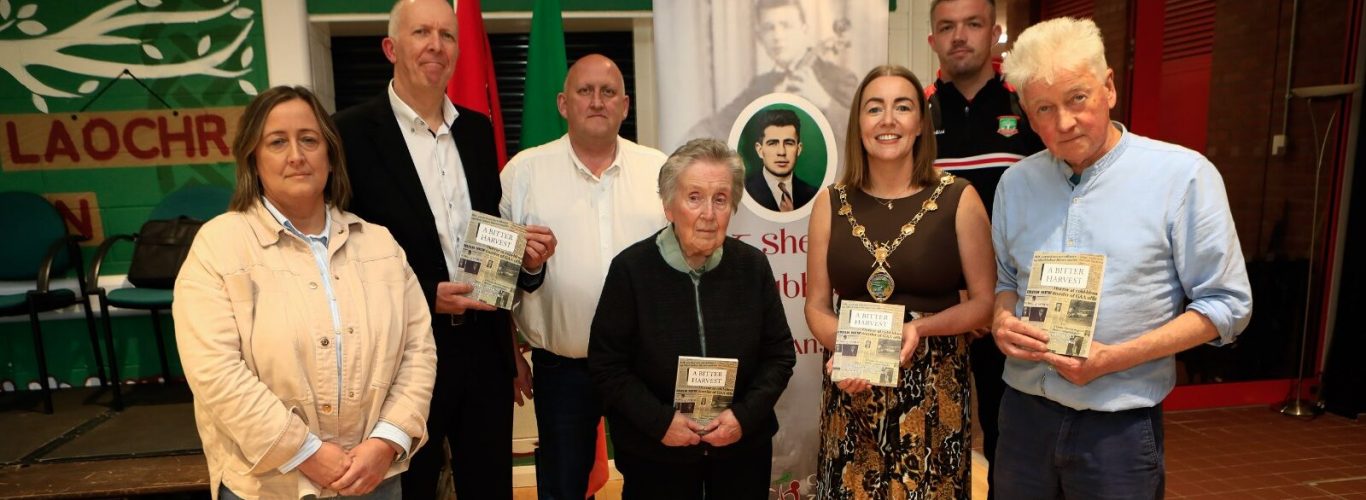
The publication of “A Bitter Harvest” by Garbhan Downey, with a foreword by Stephen Rea, therefore, is to be welcomed. It chronicles, in great detail, the long and winding road, which has been forced on the Brown family, in their quest to uncover the truth and get some justice for Seán.
What makes the story more poignant for those of us who grew up in GAA clubs throughout Ireland is that most clubs have a central figure, like Seán Brown, who hold the club together in a myriad of ways. Seán was President of Bellaghy GAA Club but representative of many others throughout Ireland. The murder of a good and innocent man and the woeful treatment of his family in the immediate aftermath, right down the almost 30 years since his death, cries out for justice to be done. It is an afront to all who believe in the rule of law.
The book also outlines that 170 members of the GAA were killed in the Troubles and describes the problems, which the GAA had, in operating in the hostile environment which pertained at the time. The book states that there was a lack of appreciation among GAA members in the Republic about the difficulties our Northern colleagues were suffering under. One exception mentioned is my old and good friend, Joe McDonagh, who attended Seán’s funeral and stood in solidarity with the club members. That was typical of Joe who was both a genuine human being and also an outstanding GAA President.
All that is very important, especially to GAA members, but the real importance of this publication lies in it revealing the whole sordid mess of connections between, not only many of the leading figures in the Loyalist Volunteer Force (LVF), but also that collusion reached deep inside the security services. Just why MI5, the British Army and the Police have fought so hard in the intervening years since Sean’s death to prevent the full disclosure of official documentation on the case is perplexing and disturbing.
The unexplained circumstances began right from the start with such a poor initial RUC investigation. That investigation ignored many basic tools of modern policing and even failed to collect forensic leads. It failed to communicate adequately with the Brown family. It has been severely criticised by all subsequent examinations of the case.
As the book points out, very serious questions also have to be asked as how and why the LVF used a lot of manpower (and in this case, also women power) on their operation to kill Sean Brown? Court documents reveal at least 25 people are suspected of involvement. The LVF is not a large organisation, with limited operational capacity, and hence how did it feel confident enough to operate a long distance from its normal base. It also appears to have believed that it was acting with impunity, including passing by the cameras of Toome police station. The book also asks why surveillance was withdrawn on the chief suspect the night before the killing and reinstated only the day afterwards. These questions will not go away. The courts have confirmed collusion with State agents in this case.
The murder occurred as the two Governments were trying to get peace negotiations off the ground. It was also just before Bertie Ahern and Tony Blair came into office and began to get things moving, which led to the Good Friday Agreement. There were strong rivalries between the LVF and their former associates in the UVF who were on cease-fire. Into that mix, were also undoubtably some in the security services uncomfortable with the direction of the peace process. Unless there are some credible answers to many legitimate questions raised by Garbhan Downey in this publication, then conspiracy theorists will have a hay day.
Given the numerous court hearings on the matter and resolute resistance of State authorities to come clean, the case for a public enquiry is overwhelming. Even the Chief Constable of the PSNI, Jon Boutcher is not opposed to one. Several High Court Judges have ruled there should be one. The Supreme Court in London may force one. In any event it is well past time to give the Brown family and especially Sean’s widow, Bridie, the truth. Only a public enquiry is capable of that
Huge credit must go to Garbhan Downey for writing this book, and to the many people who assisted Garbhan and Colmcille Press in bring the publication to fruition. The book will inevitably assist in the campaign for a public enquiry and full accountability.
The book is available on Amazon.



by Ray Bassett
The subject matter of this book, “A Bitter Harvest”, should be of major concern to us all. The murder of Seán Brown, a friend and neighbour of Nobel Prize winner Seamus Heaney. was carried out as a deep and dark operation. That an individual, who cultivated cross community links and described by follow club man, Laurence Diamond, as “a great human being”, should have been marked out for such an horrific fate, seems almost beyond comprehension. Seán Brown represented decency and community which makes what happened to him all the more unfathomable.
The publication of “A Bitter Harvest” by Garbhan Downey, with a foreword by Stephen Rea, therefore, is to be welcomed. It chronicles, in great detail, the long and winding road, which has been forced on the Brown family, in their quest to uncover the truth and get some justice for Seán.
What makes the story more poignant for those of us who grew up in GAA clubs throughout Ireland is that most clubs have a central figure, like Seán Brown, who hold the club together in a myriad of ways. Seán was President of Bellaghy GAA Club but representative of many others throughout Ireland. The murder of a good and innocent man and the woeful treatment of his family in the immediate aftermath, right down the almost 30 years since his death, cries out for justice to be done. It is an afront to all who believe in the rule of law.
The book also outlines that 170 members of the GAA were killed in the Troubles and describes the problems, which the GAA had, in operating in the hostile environment which pertained at the time. The book states that there was a lack of appreciation among GAA members in the Republic about the difficulties our Northern colleagues were suffering under. One exception mentioned is my old and good friend, Joe McDonagh, who attended Seán’s funeral and stood in solidarity with the club members. That was typical of Joe who was both a genuine human being and also an outstanding GAA President.
All that is very important, especially to GAA members, but the real importance of this publication lies in it revealing the whole sordid mess of connections between, not only many of the leading figures in the Loyalist Volunteer Force (LVF), but also that collusion reached deep inside the security services. Just why MI5, the British Army and the Police have fought so hard in the intervening years since Sean’s death to prevent the full disclosure of official documentation on the case is perplexing and disturbing.
The unexplained circumstances began right from the start with such a poor initial RUC investigation. That investigation ignored many basic tools of modern policing and even failed to collect forensic leads. It failed to communicate adequately with the Brown family. It has been severely criticised by all subsequent examinations of the case.
As the book points out, very serious questions also have to be asked as how and why the LVF used a lot of manpower (and in this case, also women power) on their operation to kill Sean Brown? Court documents reveal at least 25 people are suspected of involvement. The LVF is not a large organisation, with limited operational capacity, and hence how did it feel confident enough to operate a long distance from its normal base. It also appears to have believed that it was acting with impunity, including passing by the cameras of Toome police station. The book also asks why surveillance was withdrawn on the chief suspect the night before the killing and reinstated only the day afterwards. These questions will not go away. The courts have confirmed collusion with State agents in this case.
The murder occurred as the two Governments were trying to get peace negotiations off the ground. It was also just before Bertie Ahern and Tony Blair came into office and began to get things moving, which led to the Good Friday Agreement. There were strong rivalries between the LVF and their former associates in the UVF who were on cease-fire. Into that mix, were also undoubtably some in the security services uncomfortable with the direction of the peace process. Unless there are some credible answers to many legitimate questions raised by Garbhan Downey in this publication, then conspiracy theorists will have a hay day.
Given the numerous court hearings on the matter and resolute resistance of State authorities to come clean, the case for a public enquiry is overwhelming. Even the Chief Constable of the PSNI, Jon Boutcher is not opposed to one. Several High Court Judges have ruled there should be one. The Supreme Court in London may force one. In any event it is well past time to give the Brown family and especially Sean’s widow, Bridie, the truth. Only a public enquiry is capable of that
Huge credit must go to Garbhan Downey for writing this book, and to the many people who assisted Garbhan and Colmcille Press in bring the publication to fruition. The book will inevitably assist in the campaign for a public enquiry and full accountability.
The book is available on Amazon.