by Kevin Rooney
For several days last week I found myself in the Royal Courts of Justice watching the civil case against Gerry Adams. Three people injured in IRA bombs dating back to the 1970s, backed by a motley group including leading Tories, right wing think tanks, ex intelligence officers and unionists were hoping to demonstrate that Gerry Adams led the IRA and is therefore culpable for all their actions. “Adams may be responsible for over 1,300 murders”, wrote one tabloid headline.
The proceedings had all the trappings of a show trial. Former RUC and British intelligence officers took to the witness box, some from behind a screen, to accuse Adams of being the mastermind of the bombing campaign in Britain. Their testimony however was less concrete evidence proving Adam’s involvement in the 3 attacks, and more a mixture of rumour and hearsay easily demolished by the defence team.
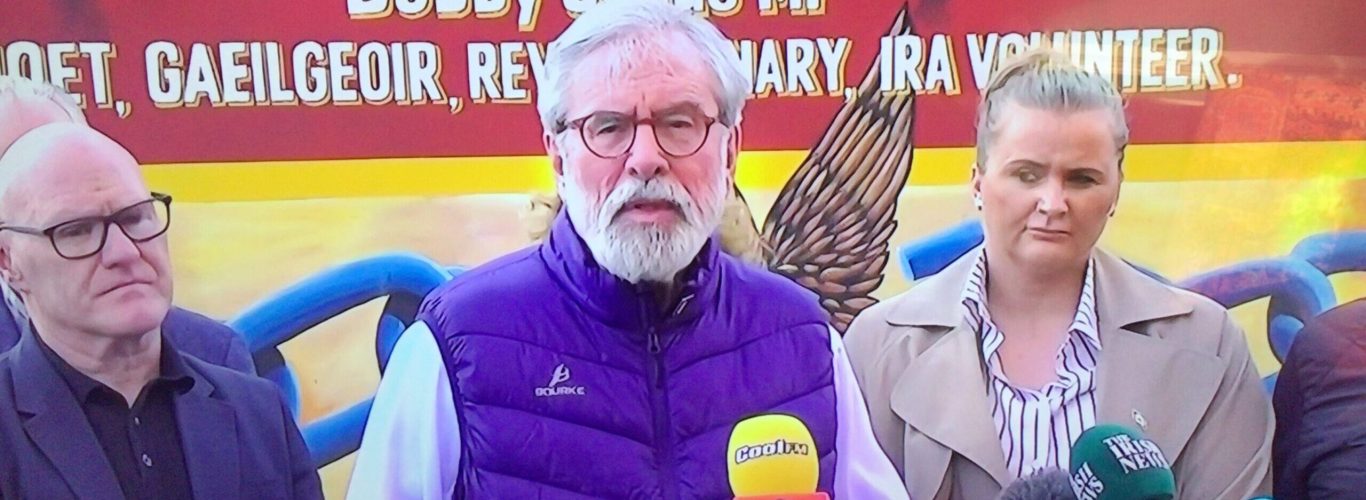
Outside court Adams said, “The only thing I am guilty of is being an Irish republican, believing in an end to British rule in our country”. Inside court even the prosecution witnesses had to concede that Gerry Adams was the foremost strategic thinker of the Troubles and the man who engineered the peace process.
What struck me when chatting to friends and colleagues about my time in court is that attempts by the establishment and tabloid press to criminalise and demonise Gerry Adams don’t seem to work anymore. The majority of ordinary English people seem to see Adams not as a hate figure but the former Sinn Fein leader who helped deliver peace. Now that the armed struggle is over, Adams’s support for an independent and united Ireland is seen as benign and non-threatening .
Adams wasn’t obliged to attend the court but chose to come and take the stand. That he managed to come across as genuinely empathetic with the 3 men bringing the case as well as robustly defending the struggle against British rule is testament to his skill as an authentic and articulate orator.
There is no doubt that the anti-republication coalition backing this case saw it as potentially seismic. If the court ruled in their favour, they would finally have the scalp they have sought for decades, and their messaging emphasised that victory would pave the way for a whole stream of civil and possible criminal cases against him.
But they have failed spectacularly. On the final day of the trial the judge dismissed the entire case, ruling that it was an abuse of process to use a personal injuries claim to challenge Adams’s wider role in the Troubles.
It’s perhaps ironic that Adams’ fate lay in the hands of the British justice system he has always lambasted. But it ends up that even in the British courts, thinly veiled hatred of your enemies is not enough to secure a conviction.
Far from demonising Adams, those backing this case provided him with a platform to articulate his support for the past struggle and his vision of Irish unity with dignity and integrity:
“I hope to see a United Ireland but if I do not I will go to my grave content that I played a role in a United Ireland”

by Kevin Rooney
For several days last week I found myself in the Royal Courts of Justice watching the civil case against Gerry Adams. Three people injured in IRA bombs dating back to the 1970s, backed by a motley group including leading Tories, right wing think tanks, ex intelligence officers and unionists were hoping to demonstrate that Gerry Adams led the IRA and is therefore culpable for all their actions. “Adams may be responsible for over 1,300 murders”, wrote one tabloid headline.
The proceedings had all the trappings of a show trial. Former RUC and British intelligence officers took to the witness box, some from behind a screen, to accuse Adams of being the mastermind of the bombing campaign in Britain. Their testimony however was less concrete evidence proving Adam’s involvement in the 3 attacks, and more a mixture of rumour and hearsay easily demolished by the defence team.
Outside court Adams said, “The only thing I am guilty of is being an Irish republican, believing in an end to British rule in our country”. Inside court even the prosecution witnesses had to concede that Gerry Adams was the foremost strategic thinker of the Troubles and the man who engineered the peace process.
What struck me when chatting to friends and colleagues about my time in court is that attempts by the establishment and tabloid press to criminalise and demonise Gerry Adams don’t seem to work anymore. The majority of ordinary English people seem to see Adams not as a hate figure but the former Sinn Fein leader who helped deliver peace. Now that the armed struggle is over, Adams’s support for an independent and united Ireland is seen as benign and non-threatening .
Adams wasn’t obliged to attend the court but chose to come and take the stand. That he managed to come across as genuinely empathetic with the 3 men bringing the case as well as robustly defending the struggle against British rule is testament to his skill as an authentic and articulate orator.
There is no doubt that the anti-republication coalition backing this case saw it as potentially seismic. If the court ruled in their favour, they would finally have the scalp they have sought for decades, and their messaging emphasised that victory would pave the way for a whole stream of civil and possible criminal cases against him.
But they have failed spectacularly. On the final day of the trial the judge dismissed the entire case, ruling that it was an abuse of process to use a personal injuries claim to challenge Adams’s wider role in the Troubles.
It’s perhaps ironic that Adams’ fate lay in the hands of the British justice system he has always lambasted. But it ends up that even in the British courts, thinly veiled hatred of your enemies is not enough to secure a conviction.
Far from demonising Adams, those backing this case provided him with a platform to articulate his support for the past struggle and his vision of Irish unity with dignity and integrity:
“I hope to see a United Ireland but if I do not I will go to my grave content that I played a role in a United Ireland”