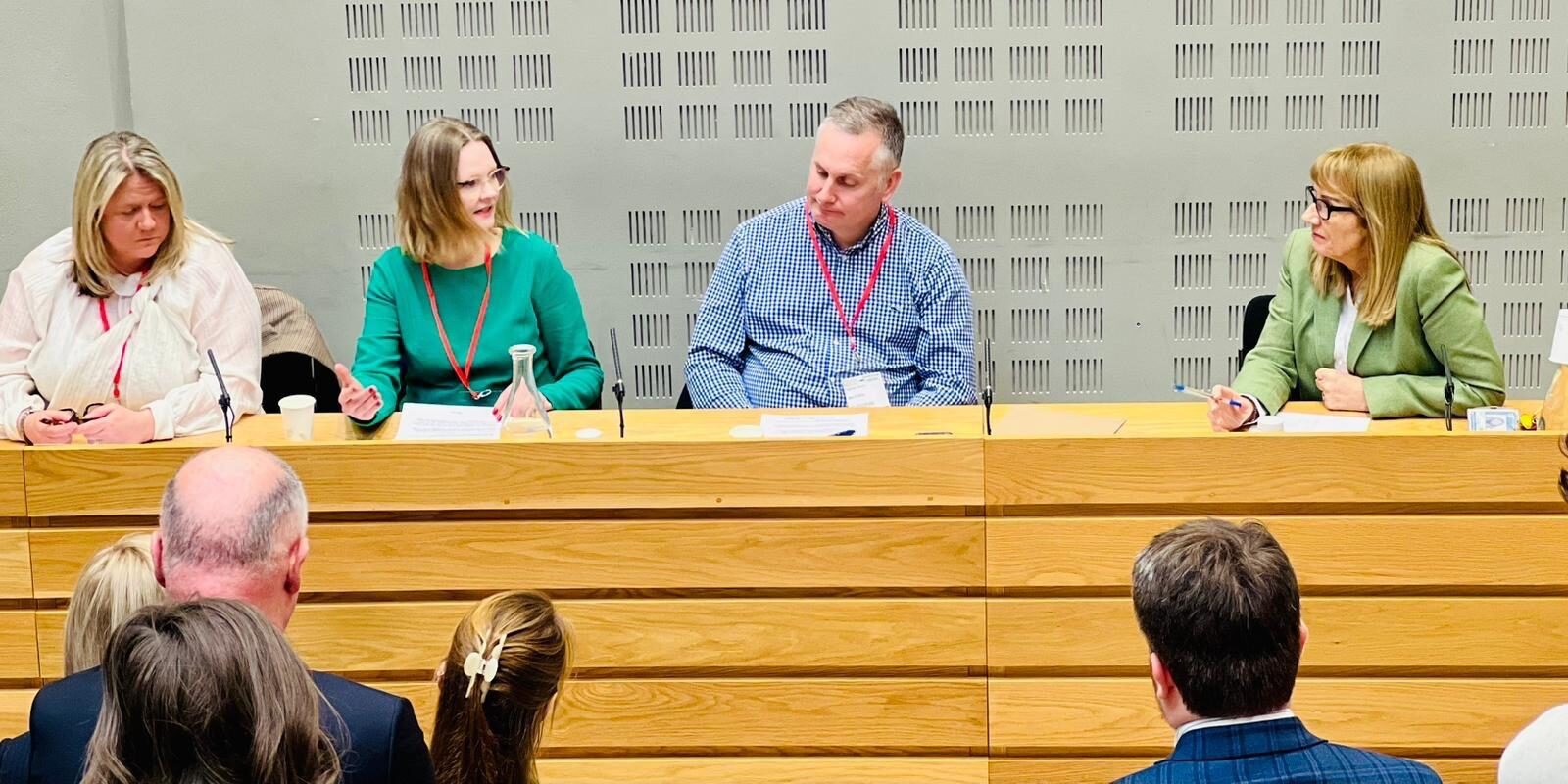
Below is the speech Claire Mitchell gave on ‘Protestant perspectives on constitutional change’ in Leinster House on Wednesday.
I grew up as a Protestant Dissenter in a very religious and also very anti-sectarian home. My parents were involved in the charismatic reconciliation movement. We are Irish and have always supported reunification, which was very much a minority position for Protestants during the Troubles.
I moved to Dublin in 1995 to study history and politics in UCD. I did a PhD in Politics with Professor Jennifer Todd, a post doc in the Institute for British Irish Studies, and then moved north again. I’ve have spent my entire adult life researching and writing about Protestant identities.
Most of my work has focused on Protestant diversity. Taking apart stereotypes, and showing how groups like evangelicals or loyalists have huge amount of internal variety.
Another central theme of my work is personal identity change over time. My most recent book was with alternative Protestants – modern day United Irishmen and women – who have moved away from unionism, especially after Brexit, and are now curious about Irish unity. 10% of Protestants in the 2024 Northern Ireland Life and Times Survey say that they would vote for Irish unity tomorrow. Many more are exploring and questioning. That is a big change.
We’re in a moment of upheaval globally as well as locally, and it won’t surprise anyone that northern Protestants are reevaluating their politics along with everybody else.
We are here today because we think that preparing for constitutional change is urgent. We understand that many would prefer a slow process. The work of the Shared Island Unit has been an invaluable building block. However, we are becoming concerned that the pace of events may be overtaking the pace of preparation.
The UK is changing rapidly. Either a Farage Reform government, or a progressive rainbow coalition, will have dramatic implications for our island. I think all roads lead to some kind of rupture.
Scottish historian Tom Devine, talking about his own journey to supporting Scottish independence, said that he didn’t leave Britain, Britain had left him.
I think that’s a good insight into how some northern Protestants feel today. People talk about their sadness that the UK does not feel like the place they grew up in.
Another urgency comes from the fact that the state of Northern Ireland is failing quite badly. Our political structures have frozen a sectarian divide in time, which has created a culture of fighting rather than proactive fixing. We have a remote Westminster that doesn’t really understand us, and a geography that doesn’t work.
But Northern Ireland is very far from a basket case. We have talent and ideas. We’re creative and resilient. We’re good at peacemaking.
From our private and public conversations, we see diverse approaches to unity amongst Protestants.
I think there are three groups at present –
First, the innovators – people who are thinking ahead and working out what needs done. We’re seeing forward thinkers from liberal, conservative and leftwing Protestant traditions now advocating for Irish unity. There are new voices joining all the time.
Second, the ostriches – those who say that unity will never happen. While I agree that northing is inevitable, this position feels like pr rather than a practical reality. Which is why some senior, retired Protestant politicians have encouraged unionists to engage, to prevent shocks later on.
Third, a very significant silent majority of people who may be pro-union or agnostic, but who are curious and somewhat flexible. My in-laws, for example, vote unionist, some voted for Brexit, they have children and grandchildren in the British army, but their worries and dreams are just the same as mine – and probably yours too.
We want all safety and a good quality of life in an insecure world.
There are things that the Irish state could credibly frame in an offer to my in-laws.
For my father in law, a devout evangelical, religious freedom, worship and assembly are incredibly important. This may be self evident, but I think it’s worth spelling out.
For the others, British passports and pensions would cover most of it.
Beyond identity and economic stability, there are important things that would appeal to many Protestants, and could form the basis of a unity offer. I will highlight just a few.
- Climate security as a small island nation. Recent years have underlined how fragile our food and energy systems are. Ordinary people pay for global shocks in Ukraine and now Iran. Lough Neagh is poisoned, which affects water both sides of the border. Sustainable and practical independence could form the basis of a unity offer. We could look at how Nordic nations have built self sufficient systems. Harness wind and sea to underpin good, stable lives. We could create green transition jobs in Larne and Laois, take public ownership of Harland and Wolff as a green engineering hub. This speaks to the concerns of everyday Protestants and unionists, while being good for everybody on the island.
- An inclusive multiethnic Republic. We could have a unity offer that protects everyone on the island, underpinned by a Bill of Rights. Where Catholics, Protestants, Others and Newcomers are all cherished equally. This takes the focus and pressure off Protestants, and helps us imagine a new Irish nation that builds naturally on legacy of 1798 and 1916.
- A regional forum or partnership of the islands, strengthening ties between a future Scotland, Wales and English regions – a modern Strand 3. Perhaps looking at our relationships to Nordic nations, as well as the EU. Regional co-operation and mutual aid will be crucial in navigating a post-Trump, climate insecure future.
The most important thing is that an Irish unity offer should be attractive for people both north and south. It needs to offer a new social contract not just for northern Protestants, but for everyone.
Arguably all this is work that is needed anyway.
Many ordinary Protestants are frustrated that some loud voices continue to dominate our politics, our media and perhaps sometimes even the southern imagination of who we are.
Some loud voices within conservative unionism have distinctive positions on the changing world order. However, many Protestants are horrified by Gaza and Trump, and are much more in step with the thinking of Irish people and the Irish state than you might assume.
I would like to suggest that the Irish state has more Protestant partners and friends in the unity project than you might think. We just need to develop the language and create a compelling offer.
For our part, we are ready and willing to do our share of the work. We have ideas, and practice of talking about constitutional change in inclusive and sensitive ways.
We’re at the point where the lack of input from the Irish state in helping to frame an offer – or even a deliberative process – limits the progress we are able to make.
My guess is that nobody in this room today will go back home tonight to a unionist and loyalist area, except the three of us. We will still live in these areas if and when constitutional change comes.
Nobody is more invested than us in securing stable, non-violent constitutional change where people in our families, neighbourhoods and communities not only feel comfortable, but are hopeful and excited about the future.
We wouldn’t be here today unless we thought that this version of Irish unity was very possible. But to build it, we have to choose to act and prepare, rather than to simply hope for the best.
Below is the speech Claire Mitchell gave on ‘Protestant perspectives on constitutional change’ in Leinster House on Wednesday.
I grew up as a Protestant Dissenter in a very religious and also very anti-sectarian home. My parents were involved in the charismatic reconciliation movement. We are Irish and have always supported reunification, which was very much a minority position for Protestants during the Troubles.
I moved to Dublin in 1995 to study history and politics in UCD. I did a PhD in Politics with Professor Jennifer Todd, a post doc in the Institute for British Irish Studies, and then moved north again. I’ve have spent my entire adult life researching and writing about Protestant identities.
Most of my work has focused on Protestant diversity. Taking apart stereotypes, and showing how groups like evangelicals or loyalists have huge amount of internal variety.
Another central theme of my work is personal identity change over time. My most recent book was with alternative Protestants – modern day United Irishmen and women – who have moved away from unionism, especially after Brexit, and are now curious about Irish unity. 10% of Protestants in the 2024 Northern Ireland Life and Times Survey say that they would vote for Irish unity tomorrow. Many more are exploring and questioning. That is a big change.
We’re in a moment of upheaval globally as well as locally, and it won’t surprise anyone that northern Protestants are reevaluating their politics along with everybody else.
We are here today because we think that preparing for constitutional change is urgent. We understand that many would prefer a slow process. The work of the Shared Island Unit has been an invaluable building block. However, we are becoming concerned that the pace of events may be overtaking the pace of preparation.
The UK is changing rapidly. Either a Farage Reform government, or a progressive rainbow coalition, will have dramatic implications for our island. I think all roads lead to some kind of rupture.
Scottish historian Tom Devine, talking about his own journey to supporting Scottish independence, said that he didn’t leave Britain, Britain had left him.
I think that’s a good insight into how some northern Protestants feel today. People talk about their sadness that the UK does not feel like the place they grew up in.
Another urgency comes from the fact that the state of Northern Ireland is failing quite badly. Our political structures have frozen a sectarian divide in time, which has created a culture of fighting rather than proactive fixing. We have a remote Westminster that doesn’t really understand us, and a geography that doesn’t work.
But Northern Ireland is very far from a basket case. We have talent and ideas. We’re creative and resilient. We’re good at peacemaking.
From our private and public conversations, we see diverse approaches to unity amongst Protestants.
I think there are three groups at present –
First, the innovators – people who are thinking ahead and working out what needs done. We’re seeing forward thinkers from liberal, conservative and leftwing Protestant traditions now advocating for Irish unity. There are new voices joining all the time.
Second, the ostriches – those who say that unity will never happen. While I agree that northing is inevitable, this position feels like pr rather than a practical reality. Which is why some senior, retired Protestant politicians have encouraged unionists to engage, to prevent shocks later on.
Third, a very significant silent majority of people who may be pro-union or agnostic, but who are curious and somewhat flexible. My in-laws, for example, vote unionist, some voted for Brexit, they have children and grandchildren in the British army, but their worries and dreams are just the same as mine – and probably yours too.
We want all safety and a good quality of life in an insecure world.
There are things that the Irish state could credibly frame in an offer to my in-laws.
For my father in law, a devout evangelical, religious freedom, worship and assembly are incredibly important. This may be self evident, but I think it’s worth spelling out.
For the others, British passports and pensions would cover most of it.
Beyond identity and economic stability, there are important things that would appeal to many Protestants, and could form the basis of a unity offer. I will highlight just a few.
The most important thing is that an Irish unity offer should be attractive for people both north and south. It needs to offer a new social contract not just for northern Protestants, but for everyone.
Arguably all this is work that is needed anyway.
Many ordinary Protestants are frustrated that some loud voices continue to dominate our politics, our media and perhaps sometimes even the southern imagination of who we are.
Some loud voices within conservative unionism have distinctive positions on the changing world order. However, many Protestants are horrified by Gaza and Trump, and are much more in step with the thinking of Irish people and the Irish state than you might assume.
I would like to suggest that the Irish state has more Protestant partners and friends in the unity project than you might think. We just need to develop the language and create a compelling offer.
For our part, we are ready and willing to do our share of the work. We have ideas, and practice of talking about constitutional change in inclusive and sensitive ways.
We’re at the point where the lack of input from the Irish state in helping to frame an offer – or even a deliberative process – limits the progress we are able to make.
My guess is that nobody in this room today will go back home tonight to a unionist and loyalist area, except the three of us. We will still live in these areas if and when constitutional change comes.
Nobody is more invested than us in securing stable, non-violent constitutional change where people in our families, neighbourhoods and communities not only feel comfortable, but are hopeful and excited about the future.
We wouldn’t be here today unless we thought that this version of Irish unity was very possible. But to build it, we have to choose to act and prepare, rather than to simply hope for the best.