By Paul Breen
John Hume once famously said that “you can’t eat a flag.” What he meant was simple. Real politics is about living standards, about social and economic development. It is not about waving bits of cloth at one another. It was a typically understated way of cutting through decades of symbolism, ritual and identity politics to get to the substance of people’s lives. And yet, here we are again, arguing about flags.
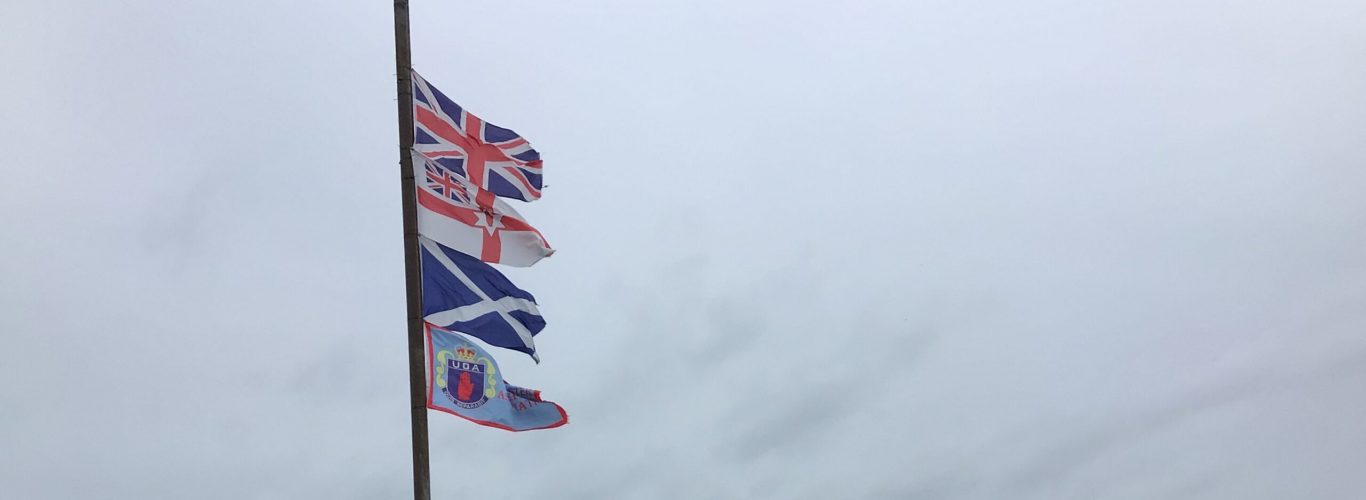
The immediate context is the renewed controversy around the Ulster Banner and whether it should continue to represent Northern Ireland at sporting events such as the Commonwealth Games. Unionist anger has been predictable and, in many cases, tone deaf to the arguments of the other side. Some reactions have been framed almost entirely in terms of loss and cultural erosion, with little realisation why others might experience this symbol differently.
For many within unionism, the Ulster Banner is simply “our flag.” It is wrapped in memory and continuity. What, they ask, could possibly be wrong with that. The problem is not that the flag exists. The problem is that it can’t represent a whole, equal society.
The Ulster Banner is the flag of a defunct one party state. It belongs to a political entity that was explicitly designed to guarantee a permanent Protestant, permanent British and permanent unionist majority. That was not an accidental outcome of partition. It was its purpose. The state was engineered to ensure control, not balance, and the flag emerged from that reality. It is inseparable from a system in which nationalists were excluded, marginalised and discriminated against. That is not abstract history. It is lived memory.
Unionist symbols are often treated as cultural, while nationalist discomfort with them is treated as political. But that distinction does not hold. Symbols are always political. They always carry histories, power relations and messages about who belongs. There are important lessons in that fact too for those of us on the side of Irish unity.
One of the striking features of contemporary debate is that nationalism has, in many ways, moved further on this question than unionism. Even within republicanism, there are long standing discussions about flags, anthems and symbols. There are serious conversations about whether Amhrán na bhFiann is fit for purpose in a shared Ireland and about what new symbols might look like in a genuinely inclusive state.
None of this is settled, but the conversation is happening. That matters when preparing for the future. Michelle O’Neill’s stance on the Ulster Banner being a decision for the team themselves, for example, was far more reasonable than anything suggested by Unionism.
Unionism, by contrast, has once again circled the wagons. The Ulster Banner is defended as tradition, as history, as something that simply is. But it was created in a very specific political context and for a very specific purpose. It is not an ancient expression of a shared society. It is a product of a state whose raison d’être was exclusion.
For some unionists, challenges to the flag feel like erasure. For others, they are read as a forewarning of change. In both cases, the instinct is defensive. But defence is not a vision. It is a posture, and one that becomes increasingly fragile as social reality shifts.
Northern Ireland today is more plural, more mixed and more complex than at any point in its history. Younger unionists are more comfortable with a progressive sense of Irishness. The old certainties are loosening. Symbolic politics, however, has not caught up.
Some people are still arguing over the old binaries of the twentieth century while living, increasingly, in a society shaped by movement, mixture and overlap. The Ulster Banner controversy is a perfect example of this lag. It’s time for change and the time is now.
A society that is increasingly shared cannot continue to be symbolically owned by one tradition. Unionism, as a political force, is weakening ideologically and electorally, but remains integral to the life of Ireland as a whole.
That’s why it is important for them to have conversations around Irish unity, to address such fears. At the very least, they should be having conversations about creating an equal, shared society within Northern Ireland. But there’s a paradox in that.
If Northern Ireland becomes a truly shared society, with symbols that grant equality to everyone, then there’s almost no need for a separate state to exist. Such a state would effectively be the same as it would in the event of Irish unity. That’s because a new agreed Ireland is also likely to be one with many more neutral symbols. And with controversies such as this, it feels as if political unionism doesn’t want to live in such a state.
There is another dimension here that is rarely acknowledged. The areas most saturated with flags are almost always the poorest. In Northern Ireland, as in parts of England, flags are concentrated most heavily in communities hollowed out by deindustrialisation and neglect. When people feel abandoned, symbolism becomes louder. When power is absent, a chauvinistic, angry nationalism fills the space. Flags, in this sense, are not just identity markers. They are often symptoms of economic and political failure.
This brings us back to John Hume. What are flags actually for. Are they there to mark territory, to assert ownership, to remind others who is in charge? Or are they there to express belonging and shared identity?
History moves. Societies evolve. Symbols either adapt or they become relics, just the same as repressive states often crumble. A new recipe for flags would not erase anyone’s story. It would make space for all. It would refuse to be imprisoned by one version of the past.
And perhaps then we could stop arguing about what we fly and start talking about how we live. Because in the end, John Hume was right. You cannot eat a flag. But you can be nourished by a society that has learned to share.
By Paul Breen
John Hume once famously said that “you can’t eat a flag.” What he meant was simple. Real politics is about living standards, about social and economic development. It is not about waving bits of cloth at one another. It was a typically understated way of cutting through decades of symbolism, ritual and identity politics to get to the substance of people’s lives. And yet, here we are again, arguing about flags.
The immediate context is the renewed controversy around the Ulster Banner and whether it should continue to represent Northern Ireland at sporting events such as the Commonwealth Games. Unionist anger has been predictable and, in many cases, tone deaf to the arguments of the other side. Some reactions have been framed almost entirely in terms of loss and cultural erosion, with little realisation why others might experience this symbol differently.
For many within unionism, the Ulster Banner is simply “our flag.” It is wrapped in memory and continuity. What, they ask, could possibly be wrong with that. The problem is not that the flag exists. The problem is that it can’t represent a whole, equal society.
The Ulster Banner is the flag of a defunct one party state. It belongs to a political entity that was explicitly designed to guarantee a permanent Protestant, permanent British and permanent unionist majority. That was not an accidental outcome of partition. It was its purpose. The state was engineered to ensure control, not balance, and the flag emerged from that reality. It is inseparable from a system in which nationalists were excluded, marginalised and discriminated against. That is not abstract history. It is lived memory.
Unionist symbols are often treated as cultural, while nationalist discomfort with them is treated as political. But that distinction does not hold. Symbols are always political. They always carry histories, power relations and messages about who belongs. There are important lessons in that fact too for those of us on the side of Irish unity.
One of the striking features of contemporary debate is that nationalism has, in many ways, moved further on this question than unionism. Even within republicanism, there are long standing discussions about flags, anthems and symbols. There are serious conversations about whether Amhrán na bhFiann is fit for purpose in a shared Ireland and about what new symbols might look like in a genuinely inclusive state.
None of this is settled, but the conversation is happening. That matters when preparing for the future. Michelle O’Neill’s stance on the Ulster Banner being a decision for the team themselves, for example, was far more reasonable than anything suggested by Unionism.
Unionism, by contrast, has once again circled the wagons. The Ulster Banner is defended as tradition, as history, as something that simply is. But it was created in a very specific political context and for a very specific purpose. It is not an ancient expression of a shared society. It is a product of a state whose raison d’être was exclusion.
For some unionists, challenges to the flag feel like erasure. For others, they are read as a forewarning of change. In both cases, the instinct is defensive. But defence is not a vision. It is a posture, and one that becomes increasingly fragile as social reality shifts.
Northern Ireland today is more plural, more mixed and more complex than at any point in its history. Younger unionists are more comfortable with a progressive sense of Irishness. The old certainties are loosening. Symbolic politics, however, has not caught up.
Some people are still arguing over the old binaries of the twentieth century while living, increasingly, in a society shaped by movement, mixture and overlap. The Ulster Banner controversy is a perfect example of this lag. It’s time for change and the time is now.
A society that is increasingly shared cannot continue to be symbolically owned by one tradition. Unionism, as a political force, is weakening ideologically and electorally, but remains integral to the life of Ireland as a whole.
That’s why it is important for them to have conversations around Irish unity, to address such fears. At the very least, they should be having conversations about creating an equal, shared society within Northern Ireland. But there’s a paradox in that.
If Northern Ireland becomes a truly shared society, with symbols that grant equality to everyone, then there’s almost no need for a separate state to exist. Such a state would effectively be the same as it would in the event of Irish unity. That’s because a new agreed Ireland is also likely to be one with many more neutral symbols. And with controversies such as this, it feels as if political unionism doesn’t want to live in such a state.
There is another dimension here that is rarely acknowledged. The areas most saturated with flags are almost always the poorest. In Northern Ireland, as in parts of England, flags are concentrated most heavily in communities hollowed out by deindustrialisation and neglect. When people feel abandoned, symbolism becomes louder. When power is absent, a chauvinistic, angry nationalism fills the space. Flags, in this sense, are not just identity markers. They are often symptoms of economic and political failure.
This brings us back to John Hume. What are flags actually for. Are they there to mark territory, to assert ownership, to remind others who is in charge? Or are they there to express belonging and shared identity?
History moves. Societies evolve. Symbols either adapt or they become relics, just the same as repressive states often crumble. A new recipe for flags would not erase anyone’s story. It would make space for all. It would refuse to be imprisoned by one version of the past.
And perhaps then we could stop arguing about what we fly and start talking about how we live. Because in the end, John Hume was right. You cannot eat a flag. But you can be nourished by a society that has learned to share.